Mega-budget superhero movie
“RA.One” is Shah Rukh Khan’s
most ambitious project and he is
trying to make it a world-class
film, but at the same time he
feels Indian filmmakers cannot
compete with international
moviemakers in the use of
technology.
“I don’t think we are anywhere
close to competing with
international filmmakers. I don’t
mean to offend anyone. We
have great storytelling, good
technology and do great stuff…
we are the largest film
producing nation in the world!
“But having said that, when it
comes to technology in films like
‘Batman’, ‘Superman’ and
‘Spiderman’, I don’t think we
should even try to compare
ourselves to them as yet. They
are way ahead. Their resources
are really huge compared to
what we can do,” Shah Rukh
told reporters here.
“RA.One” is directed by
Anubhav Sinha and the 45-year-
old plays the superhero in the
film. His costume, described as
stiff and heavy, has been
designed by a team of
specialists in Los Angeles.
“It’s fortunate that I have the
resource to take ‘RA.One’ to a
certain level. I don’t have the
resources to take it to a bigger
level yet, but if the market for
Indian films increases, of course
we can do it.‘RA.One’ is the first
step towards that,” said the
actor-producer who is co-
producing it with Eros
Entertainment.
The budget of “RA.One” is said
to be over Rs.100 crore and
Shah Rukh said he might have
certain stunts in 3D to woo his
younger audiences.
“RA.One”, which is replete with
visual effects, also promises to
change the movie-going
experience for cinegoers here.
For the first time, the Dolby
surround 7.1 system is
reportedly being installed in
several multiplexes in the run-up
to the film’s release.
The technical team of “RA.One”,
including Oscar-winning sound
engineer Resul Pookutty, headed
by Shah Rukh will be in Los
Angeles this month to work on
the special sound effects.
Internationally acclaimed
filmmaker Shekhar Kapur has
already showered praise on the
film after seeing its 30-second
trailer, saying“RA.One” has
raised bar on VFX technology in
Indian cinema.
It’s payback time for him, says
Shah Rukh, who plans to cash in
on the Diwali season by
releasing the film, which also
stars Arjun Rampal and Kareena
Kapoor, Oct 26.
“I have worked for 20 years in
this industry and I owe my life
to it. I feel this is what I would
like to give back– I give this
technology to all new directors
and actors so that they feel‘Yes,
we can do it’ and much cheaper
than Hollywood. I hope the
scope and audiences of Indian
films increases and we get more
money to make good films as
wonderful as‘Iron Man’ and
‘Spiderman’,” he added.
Shah Rukh is not hopeful of his
film being picked as India’s
official entry for the Oscars, but
he will be content with a
welcome response from the
audiences and a Filmfare award
or two!
“I don’t think it’s our choice that
which film must go for the
Oscars from our country. I don’t
know the process…I don’t know
if popular cinema should go for
it, or our parallel cinema, like
‘Paheli’ was. But franky, I don’t
think this film (‘RA.One’) will be
chosen as an Oscar nomination
from our country,” he said.
“I think I’ll be happy with one or
two Filmfare awards for the VFX
in my film,” he added in his
trademark witty style.
Shah Rukh’s earlier production
venture “Paheli” was short-
listed as India’s official entry to
Oscars by the Film Federation of
India (FFI) in 2006.
“I was shocked when ‘Paheli’
was selected,” said SRK.

Saturday, 4 June 2011

Salman Khan Wants To Show''Chillar Party''
Bollywood
star Salman Khan wants to show
“Chillar Party”, his first venture
under his banner Salman Khan
Being Human Productions, to
Minister for Information and
Broadcasting Ambika Soni.
“I want to show this film to
Ambika Soni to make it tax free.
Let’s see if that happens,”
Salman told reporters here
Friday night.
The actor had come to launch
the first promo of the film that
will release July 8 and is his co-
production with UTV. It has
been helmed by first-time
directors Nitesh Tiwari and
Vikas Bahl.
“Chillar Party” is a film about a
gang of innocent yet feisty kids
from Chandan Nagar in whose
lives enter two strangers. The
film describes how things
revolve around their lives.
Khan, on being asked whether
he would produce more films
under his banner, said:“We will
produce more films. When we
get good scripts and good films
to make, we will definitely
produce them.”
A Strange Love Story Movie Review
 | ||
| |
A few weeks back, RAGINI MMS released, which had a blend of sex and horror. Now, A STRANGE LOVE STORY goes a step further by mixing love, horror, suspense and murder mystery.
The film is about a photographer Kabeer (Eddie Seth), who's an expert in getting work done at the last moment. He invites trouble by shooting at a haunted dargah in the night, despite being warned by his friend Jennifer (Riya Sen). A few minutes after he starts shooting, Jennifer mysteriously passes out. After this incident, weird things start happening with Jennifer as she feels the presence of a person around her, who can't be seen. She's also accused of killing Kabeer's friend Baljeet Billy (Raj Zutshi), after which Inspector Iqbal (Ashutosh Rana) arrives from Delhi to investigate the case. A sequence of incredulous events ensues.
Directors Tarique Khan and Sahil Seth have tried their hands at various things, but the outcome is hideously unfavourable. The script is haphazard and after a few minutes you wonder what is going on. As if all the humdrum sequences weren't enough, a random song intended to showcase the dancing abilities of Kabeer, is thrown at you. The climax is ludicrous, and like almost the entire film, defies all logic.
The bad performances only add to the agony. Eddie Seth makes a pathetic debut. Riya Sen (seen in minimal clothing) is passable. Ashutosh Rana fails to impress. Raj Zutshi hams. All the other actors don't add any merit.
A STRANGE LOVE STORY is not only strange but outrageous. Watch it only if you find a skimpily clad Riya Sen alluring.
REVIEW: Mr. Nice Spins a Tall Tale of Drug Smuggling and Derring-do

 Self-mythology has a bad name, especially among honest, discreet folk who prefer to downplay their good qualities and undersell their achievements. To hell with that: Mr. Nice is a devilish and entertaining little picture based on the possibly somewhat true story of Howard Marks, who began life in a humble middle-class family in Wales, got into Oxford just by being a really smart kid, and eventually realized he could make a lot more money smuggling drugs from the Middle East into the United Kingdom (and later into the States) than he could by teaching. Marks outfoxed the authorities for years, before finally getting caught in 1988. He served seven years in an American prison before emerging with the 1996 autobiography, full of tall tales and derring-do, on which this movie is based.
You don’t have to believe all of it — or even any of it — to enjoy the rascally charms of Mr. Nice, which was written and directed by Bernard Rose. Actually, the movie was written, directed, shot and co-edited by Bernard Rose, which sort of makes him a virtual one-man band, like Dick Van Dyke in Mary Poppins. But any potential control-freak tendencies on Rose’s part probably work in the movie’s favor: He’s dealing, after all, with a character who’s written himself to be larger than life. Why not pull out all the stops?
Rhys Ifans plays Marks, who, as a young post-graduate trying to make it as a teacher in early ’70s London, learns all too quickly how easy it is to smuggle hashish across international borders without getting caught. He’s a gentleman among smugglers, and also a ladykiller: After the dissolution of an early, hasty marriage, he meets sexy, drowsy-eyed blond Judy (Chloë Sevigny), who will eventually bear him three kids. As a couple, the two have their ups and downs: During the rough times, when Marks has to lie low to avoid arrest, they’re stuck hiding out in a camper van. But when times are good, they’re really good, involving lots of Studio 54 revelry and palatial digs in Majorca. That’s when it really is pretty nice to be Mr. Nice, which is one of the pseudonyms Marks used to escape arrest.
But wait, there’s more: Because Marks had professional ties with an IRA wheeler-dealer (played, with a suitable degree of explosive craziness, by David Thewlis), he was eventually recruited as a spy by the British government. Drug smuggler, double-agent, raconteur: You couldn’t make this stuff up. Though there’s no doubt that Marks, in his own telling of the story, embellished it plenty, and in bringing it to the screen, Rose — who may be best known as the director of the 1992 cult favorite Candyman, starring Virginia Madsen — runs with that go-for-broke spirit. At one point Marks reveals, in a purring voice-over, that the IRA, the DEA, customs and excise, the police and the press are all after him. He’s been a very bad boy, and he’s loved every minute of it.
Ifans, wearing a lush, shaggy dark wig, is great fun to watch — he looks like a rangier, more dissolute David Cassidy.Ifans, wearing a lush, shaggy dark wig, is great fun to watch — he looks like a rangier, more dissolute (and much sexier) David Cassidy. And as Ifans handles it, Marks’ continual self-aggrandizing becomes a form of entertainment by itself: There’s enough “Who, me?” self-deprecation lurking beneath his braggadocio to keep us from hating him. That, and the fact that he really did suffer in prison. (We become witnesses to a rather unpleasant tooth-pulling scene.)
But even then, Marks does good by teaching his fellow inmates English and even, in some cases, using his prodigious coconut to help them obtain shorter sentences. (His own sentence was originally close to 25 years; he was released on parole in the mid-1990s. He also insists that he never dealt in hard drugs.) Marks is the scrapper who always comes out on top, although when he brags at one point in the film, “I’d just imported enough Columbian marijuana into the UK to get every inhabitant of the British Isles stoned,” we can see why he’s headed for a fall. Not because what he’s doing is wrong, but because he needs a rest — no one can keep up that pace for a lifetime. Rose doesn’t lay out Marks’ story as clearly as he might have — certain details and chronologies become tangled and murky — but as a portrait of a charming rapscallion and entrepreneur, Mr. Nice serves admirably. As the Small Faces sang in their own drug-dealer paean Here Comes the Nice, “I’d be just like him, if I only could.” Luckily, there’s room in the world for only one.
Friday, 3 June 2011
REVIEW: McAvoy and Fassbender Are First-Rate in X-Men: First Class


X-Men: First Class wants to be five movies at once, and it occasionally succeeds at being a few of them: One minute it’s a stylish James Bond-style retro pleaser, the next a bitter-edged revenge melodrama, the next your boilerplate “embrace individuality” empowerment brief. It is also, of course, a movie based on a comic-book franchise — in this case, Marvel’s long-running, multi-tentacled X-Men saga — and for that reason alone, it comes with a million other expectations attached. I don’t know what director in his right mind would want to take on such a project, but I admire Matthew Vaughn for trying.
And he tries hard to make X-Men: First Class all things to all people, to the extent that some of it sticks quite well. X-Men: First Class opens in Nazi Germany, just as a young lad named Erik Lehnsherr is being wrest from his parents en route to the death camps. Eric is so distraught at the separation that, even as he’s being restrained by Nazi guards, he opens and mangles a set of heavy iron gates seemingly at will. This performance intrigues mad-doctor-type Sebastian Shaw (Kevin Bacon, wearing the perfect know-it-all sneer for this sort of villainy), who orders Erik to move a coin on command. When the boy fails, Shaw shoots his mother in his presence, unleashing a storm of rage that reveals the extent of Erik’s powers.Meanwhile, over in Westchester, N.Y., a youngster named Charles Xavier discovers a girl with blue skin hiding out in his kitchen.Meanwhile, over in Westchester, N.Y., a youngster named Charles Xavier discovers a girl with blue skin hiding out in his kitchen. Fast-forward to 1962: Erik (now played by a dashing Michael Fassbender, in a series of Cary Grant turtlenecks) and Charles (James McAvoy, whose lips always manage to look just-bitten) are hurtling along separate paths but are soon destined to meet. Erik wants to wreak revenge on the man who caused him so much childhood trauma; Charles is an Oxford-educated smarty-pants whose specialty is mutant genetics. (Handily, he can also read minds.) Before long, the two have rather uneasily joined forces and collected a coterie of comely young people with interesting skills, including Havok (Lucas Till), who summons killer hula-hoops of fire from his fingertips; Beast (Nicolas Hoult), a shy nerd whose attempts to “cure” his apelike mutant aberrations backfire; Angel (Zoë Kravitz), a go-go dancer who sprouts dragonfly wings at will; and blue-girl-grown-up Mystique (a subdued but not unappealing Jennifer Lawrence), a willful beauty who, when not completely encased in matte blue scales, can temporarily assume the form of anyone she chooses.
You’ve seen these characters before, in different, more aged iteratons: X-Men: First Class is a prequel to Bryan Singer’s X-Men pictures. (Singer is one of the movie’s producers, and is credited with co-writing the story on which the script is based; the screenplay was written by Ashley Miller, Zack Stentz, Jane Goldman and Vaughn.) Fassbender’s Erik will eventually become Ian McKellan’s Magneto; McAvoy will assume the form of Patrick Stewart’s Charles Xavier. And Lawrence’s Mystique Jr. will stretch out, and fill out, just a bit more to become Rebecca Romijn’s cobalt-hued hottie (a transformation that’s alluded to in one of the picture’s several X-planatory in-jokes).

In laying out the X-Men backstory, Vaughn has done lots of things right. In the first half, in particular, he’s conscious of keeping the story grounded on a modest, human scale that isn’t overshadowed by booming special effects. Maybe that’s the approach you’d expect Vaughn to take. Together, Vaughn’s movies — which also include the gritty Brit-crime caper Layer Cake and the spirited but not-quite-cohesive Kick-Ass, as well as the flawed but still hypnotic Neil Gaiman adaptation Stardust — are a motley group that nevertheless come with a sensibility attached. Vaughn is interested in human interaction, in vulnerability, in glancing humor rather than heavy-duty laughs. His instincts are good, though he doesn’t always follow them fully — or perhaps, depending on who’s holding the purse-strings, he isn’t always allowed to.
There are some superb Bond-style sparkling phallic submarines, and we get to see January Jones, as mind-reading ice-maiden Emma Frost, in a series of Emma Peel-style zippered jumpsuits.And so while X-Men: First Class at first takes its source material with just the right amount of self-deprecating seriousness, it founders in the second half, when it becomes overburdened with squirrelly plot mechanics and an excess of self-evident dialogue. (Sample mutant talk: “Society should try to become more like us.”) X-Men: First Class wants to give itself over to stylized stylishness early on: There are some superb Bond-style sparkling phallic submarines, and we get to see January Jones, as mind-reading ice-maiden Emma Frost, in a series of Emma Peel-style zippered jumpsuits. (X-Men: First Class does commingle 1962 Mad Men-era fashion a bit too liberally with 1968 Austin Powers mod garb, but costume designer Sammy Sheldon may have been going for a vibe rather than spot-on historical accuracy.)
I hooted and laughed when Fassbender’s Erik extracted a gold filling from a baddie simply by holding his quivering hand aloft, as if he were playing a theremin. There’s also a marvelous sequence in which the youngsters amuse themselves while holed up at a CIA research facility: They strut their superpowers to the rockin’ strains of “Hippy Hippy Shake.” But X-Men: First Class becomes bogged down in its late — and seemingly everlasting — action sequences, which it frames in terms of real-life Cold War horrors. The resulting geopolitical action fable is too clever by half, and it’s wearying to watch, not least because it drains our attention from the movie’s two star attractions.
Because if nothing else, X-Men: First Class is anchored by two superb actors, McAvoy and Fassbender, who embrace this sometimes ludicrous material without acting as if they’re slumming (or just collecting a paycheck). Fassbender, born in Germany and raised in Ireland, is something of a magnificent mutant himself — his Erik Lehnsherr is urbane, unflinching, unapologetically sexy in a menacing way. (He also manages to look surprisingly not-ridiculous in that absurd Magneto helmet.) And McAvoy brings thespian gravity even to that old-timey chestnut of a line, “I can’t feel my legs.” When he suffers, his eyes stare into space, but they’re hardly blank. He and Fassbender circle each other warily, like elegant but very different animals, one feral, one cautious and intuitive. Instead of stooping down to the material, they do the work of elevating it, and they’re a pleasure to watch even as X-Men: First Class derails around them. Sometime partners who end up rivals, they’re the movie’s most spectacular special effect.
Green Lantern
 |
 June 1st, 2011
 popcornt (online)
Each Green Lantern possesses a power ring and power lantern that gives the user great control over the physical world as long as the wielder has sufficient willpower and strength to wield it. The ring is one of the most powerful weapons in the universe, and can be very dangerous. While the ring of the Golden Age Green Lantern (Alan Scott) was magically powered, the rings worn by all subsequent Lanterns were technological creations of the Guardians of the Universe, who granted such rings to worthy candidates. These individuals made up the intergalactic police force known as the Green Lantern Corps.[2]
After World War II, when sales of superhero comic books generally declined, DC ceased publishing new adventures of Alan Scott as the Green Lantern. In 1959, at the beginning of the Silver Age of Comic Books, DC editor Julius Schwartz assigned writer John Broome and artist Gil Kane to revive the Green Lantern character, this time as test pilot Hal Jordan, who became a founding member of the Justice League of America. In 1970, writer Denny O’Neil and artist Neal Adams teamed Green Lantern with archer Green Arrow in groundbreaking, socially conscious, and award-winning stories that pitted the sensibilities of the law-and-order-oriented Lantern with the populist Green Arrow. Several cosmically themed series followed, as did occasional different individuals in the role of Earth’s Green Lantern. Most prominent of these are John Stewart, Guy Gardner, Hal Jordan and Kyle Rayner.
Each of the Earth’s Green Lanterns has been a member of either the Justice Society of America or the Justice League of America, and John Stewart was featured as one of the main characters in both the Justice League and the Justice League Unlimited animated series. The Green Lanterns are often depicted as being close friends of the various men who have been the Flash, the most notable friendships having been between Alan Scott and Jay Garrick (the Golden Age Green Lantern and Flash), Hal Jordan and Barry Allen (the Silver Age Green Lantern and Flash), and Kyle Rayner and Wally West (the modern age Green Lantern and Flash), as well as Jordan being friends with West.
Publication history
Golden Age


Art by Sheldon Moldoff.
This Green Lantern’s real name was Alan Scott, and he was a railroad engineer who had come into possession of a magic lantern after a railway crash which spoke to him and said it would bring power. From this, he crafted a magic ring which gave him a wide variety of powers. The limitations of the ring were that it had to be “charged” every 24 hours by touching it to the lantern for a time, and that it did not work on non-metals like wood.
Nodell had originally planned to give the Green Lantern the alter ego “Alan Ladd,” this being a linguistic twist on Aladdin, who had a magic lamp and magic ring of his own. DC considered the wordplay distracting and foolish, and the character’s name was changed before publication to “Alan Scott.” In May 1942, the film This Gun for Hire suddenly made the journeyman actor Alan Ladd a movie star. Nodell would always joke that they’d missed a great opportunity.[4]
The Green Lantern was a popular character in the 1940s, featured in both All-American Comics and in his own title and co-starring in Comic Cavalcade along with Flash and Wonder Woman. He was a charter member of the Justice Society of America, whose adventures ran in All Star Comics. After World War II, the popularity of superheroes declined. The Green Lantern comic book was cancelled with issue #38 (May–June 1949). All Star Comics #57 (1951) was the character’s last Golden Age appearance.
Silver Age revival

This Green Lantern was Hal Jordan, a test pilot who was given a power ring by a dying alien, Abin Sur, and who became a member of the Green Lantern Corps, an interstellar organization of police overseen by the Guardians of the Universe. The Corps’ rings were powerless against anything colored yellow, due to a yellow-colored “dopant” in the master power generator located on Oa, where the Guardians maintained their headquarters, without which dopant the master generator would not function as such. Jordan’s creation was motivated by a desire to make him more of a science fiction hero, editor Julius Schwartz having been a longtime fan of that genre and literary agent who saw pop-culture tastes turning in that direction.
Later developments
With issue #76 (April 1970), the series made a radical stylistic departure. Editor Schwartz, in one of the company’s earliest efforts to provide more than fantasy, worked with the writer-artist team of Denny O’Neil and Neal Adams to spark new interest in the comic and address a perceived need for social relevance. They added the character Green Arrow (with the cover though not the official name retitled Green Lantern Co-Starring Green Arrow) and had the pair travel through America encountering “real world” issues, to which they reacted in different ways — Green Lantern as fundamentally a lawman, Green Arrow as a liberal iconoclast. Additionally during this run, the groundbreaking “Snowbirds Don’t Fly” story was published (issues #85 and #86) in which Green Arrow’s teen sidekick Speedy (the later grownup hero Red Arrow) developed a heroin addiction that he was forcibly made to quit. The stories were critically acclaimed, with publications such as The New York Times, The Wall Street Journal, and Newsweek citing it as an example of how comic books were “growing up”.[5] However, the O’Neil/Adams run was not a commercial success, and after only 14 issues, the two left the title, which was cancelled.The title would know a number of revivals and cancellations. Its title would change to Green Lantern Corps at one point as the popularity rose and waned. During a time there were two regular titles, each with a Green Lantern, and a third member in the Justice League. A new character, Kyle Rayner, was created to become the feature while Hal Jordan first became the villain Parallax, then died and came back as the Spectre.
In the wake of The New Frontier, writer Geoff Johns returned Hal Jordan as Green Lantern in Green Lantern: Rebirth (2004–05). Johns began to lay groundwork for “Blackest Night” (released July 13, 2010[6]), viewing it as the third part of the trilogy started by Rebirth. Expanding on the Green Lantern mythology in the second part, “Sinestro Corps War” (2007), Johns, with artist Ethan van Sciver, found wide critical acclaim and commercial success with the series, which promised the introduction of a spectrum of colored “lanterns”. Currently, all four “current” Green Lanterns have stories being told in simultaneously published series: Green Lantern (primarily Jordan), Green Lantern Corps (primarily Rayner and Stewart), and Green Lantern: Emerald Warriors (primarily Gardner).
Awards
The series and its creators have received several awards over the years, including the 1961 Alley Award for Best Adventure Hero/Heroine with Own Book; and Academy of Comic Book Arts’ Shazam Award for Best Continuing Feature in 1970, for Best Individual Story (“No Evil Shall Escape My Sight”, Green Lantern vol. 2, #76, by Dennis O’Neil and Neal Adams), and in 1971 for Best Individual Story (“Snowbirds Don’t Fly”, Green Lantern vol. 2, #85 by O’Neil and Adams).Writer O’Neil received the Shazam Award for Best Writer (Dramatic Division) in 1970 for his work on Green Lantern, Batman, Superman, and other titles, while artist Adams received the Shazam for Best Artist (Dramatic Division) in 1970 for his work on Green Lantern and Batman. Inker Dick Giordano received the Shazam Award for Best Inker (Dramatic Division) for his work on Green Lantern and other titles.
In Judd Winick’s first regular writing assignment on Green Lantern, he wrote a storyline in which an assistant of Kyle Rayner’s emerged as a gay character in Green Lantern #137 (June 2001). In Green Lantern #154 (November 2001) the story entitled “Hate Crime” gained media recognition when Terry was brutally beaten in a homophobic attack. Winick was interviewed on Phil Donahue’s show on MSNBC for that storyline on August 15, 2002 and received two GLAAD awards for his Green Lantern work.In May of 2011,Green Lantern placed 7th on IGN’s Top 100 Comic Book Heroes of All Time.[5]
Fictional character biographies
Golden Age Green Lantern
Alan Scott
Main article: Alan Scott
Alan Scott’s Green Lantern history traditionally began thousands of years ago when a mystical “green flame” meteor fell to Earth in ancient China. The voice of the flame prophesied that it would act three times: once to bring death (a lamp-maker crafted the green metal of the meteor into a lamp; in fear and as punishment for what they thought sacrilege, the local villagers killed him, only to be destroyed by a sudden burst of the green flame), once to bring life (in modern times, the lamp came into the hands of a patient in a mental institution who fashioned the lamp into a modern lantern; the green flame restored him to sanity and gave him a new life), and once to bring power. By 1940, the lantern passed into the possession of Alan Scott, a young engineer. Following a railroad-bridge collapse of which he was the only survivor, the flame instructed Scott how to fashion a ring from its metal, to give him fantastic powers as the superhero Green Lantern. He adopted a colorful costume and became a crime-fighter. Alan was a founding member of the Justice Society of America.After the Crisis on Infinite Earths (although the original origin story was still in continuity), a later Tales of the Green Lantern Corps story was published that brought Scott even closer to the Corps’ ranks, when it was revealed that Alan Scott was predated as Earth’s Green Lantern by a Green Lantern named Yalan Gur, a resident of China. Not only had the Corps’ now-familiar green, black and white uniform motif not yet been adopted, but Yalan Gur altered the basic red uniform to more closely resemble the style of clothing worn by his countrymen. Power ultimately corrupted this early Green Lantern, as he attempted to rule over mankind, which forced the Guardians to cause his ring to manifest a weakness to wood, the material from which most Earth weapons of the time were fashioned. This allowed the Chinese peasants to ultimately defeat their corrupted “champion.” His ring and lantern were burned and it was during this process that the “intelligence” inhabiting the ring and the lantern, and linking them to the Guardians, was damaged. Over time, when it had occasion to manifest itself, this “intelligence” became known as the mystical ‘Starheart’ of fable.
Centuries later, it was explained, when Scott found the mystical lantern, it had no memory of its true origins, save a vague recollection of the uniform of its last master. This was the origin of Scott’s distinctive costume. Due to its damaged link to them, the Guardians presumed the ring and lantern to be lost in whatever cataclysm overcame their last owner of record. Thus Scott was never noticed by the Guardians and went on to carve a history of his own apart from that of the Corps, sporting a ring with an artificially induced weakness against anything made of wood. Honoring this separate history, the Guardians never moved to force Scott to relinquish the ring, formally join the Corps, or adopt its colors. Some sort of link between Scott and the Corps, however, was hinted at in a Silver Age cross-over story which depicts Scott and Hal Jordan charging their rings at the same Power Battery while both reciting the “Brightest Day” oath. During the Rann-Thanagar War, it was revealed that Scott is an honorary member of the Corps.
Silver Age Green Lantern
Hal Jordan
Main article: Hal Jordan
The second Green Lantern to see publication is also the most notable. The character of Harold “Hal” Jordan was a second-generation test pilot, having followed in the footsteps of his father, Martin Jordan. He was given the power ring and battery (lantern) by a dying alien named Abin Sur, whose spaceship crashed on Earth. Abin Sur used his ring to seek out an individual who was “utterly honest and born without fear” to take his place as Green Lantern. Jordan became a founding member of the Justice League of America and as of the mid-2000s is, along with John Stewart, one of the two active-duty Lanterns in Earth’s sector of space.Jordan was also a member of the Green Lantern Corps, which bears some similarities to the “Lensmen” from the science fiction novel series written by E.E. Smith, although both Julius Schwartz and John Broome denied ever reading Smith’s stories.[7] Nonetheless, the early 1980s miniseries “Green Lantern Corps” honors the similarity with two characters in the corps: Eddore of Tront and Arisia. A different interpretation of Jordan and the Corps appears in Superman: Red Son.
Following the rebirth of Superman and the destruction of Green Lantern’s hometown of Coast City in the early 1990s, Hal Jordan seemingly went insane and destroyed the Green Lantern Corps and the Central Power Battery. Now calling himself Parallax, Hal Jordan would devastate the DC Universe off and on for the next several years. However, after Earth’s sun was threatened by a Sun-Eater, Jordan sacrificed his life, expending the last of his vast power to reignite the dying star. Jordan subsequently returned from beyond the grave as the Spectre, the divine Spirit of God’s Vengeance, whom Jordan attempted to transform into a Spirit of Redemption, which ended in failure.
In Green Lantern: Rebirth, it is revealed that Jordan was under the influence of a creature known as Parallax when he turned renegade. Parallax was a creature of pure fear that had been imprisoned in the Central Power Battery by the Guardians of the Universe in the distant past. Imprisonment had rendered the creature dormant and it was eventually forgotten, becoming known merely as the “yellow impurity” in the power rings. Sinestro was able to wake Parallax and encourage it to seek out Hal Jordan as a host. Although Parallax had been trying to corrupt Jordan (via his ring) for some time, it was not until after the destruction of Coast City that it was able to succeed. It took advantage of Jordan’s weakened emotional state to lure him to Oa and cause him to attack anyone who stood in his way. After killing several Green Lanterns, Jordan finally entered the Central Power Battery and absorbed all the power, unwittingly freeing the Parallax entity and allowed it to graft onto his soul.
The Spectre bonded with Jordan in the hopes of freeing the former Green Lantern’s soul from Parallax’s taint, but was not strong enough to do so. In Green Lantern: Rebirth, Parallax began to assert control of the Parallax-Spectre-Jordan composite. Thanks to a supreme effort of will, Jordan was able to free himself from Parallax, rejoin his soul to his body and reclaim his power ring. The newly revived (and rejuvenated) Jordan awoke just in time to save Kyle Rayner and Green Arrow from Sinestro. After the Korugarian’s defeat, Jordan was able to successfully lead his fellow Green Lanterns in battle against Parallax and with help from Guardians Sayd and Ganthet, imprisoned it within the personal power batteries of Earth’s Lanterns, rendering the Green Lantern’s rings free of the yellow impurity, provided they had the power of will to do so. Hal Jordan is once again a member of both the Justice League and the Green Lantern Corps, and along with John Stewart is one of the two Corps members assigned to Sector 2814, personally defeating Sinestro in the Sinestro Corps War. Jordan is designated as Green Lantern 2814.1.
Post-”Sinestro Corps War”, DC Comics revisited the origin of Hal Jordan as a precursor to “The Blackest Night” storyline, the next chapter in the Geoff Johns era on Green Lantern. Hal Jordan is the Green Lantern that will be portrayed by Ryan Reynolds in the upcoming Green Lantern film.
Bronze Age Green Lanterns
Guy Gardner
Main article: Guy Gardner (comics)
In the late 1960s, Guy Gardner appeared as the second choice to replace Abin Sur as Green Lantern of sector 2814. Gardner was originally supposed to receive Abin Sur’s ring, but Jordan was closer. This placed him as the “backup” Green Lantern for Jordan. But early in his career as a Green Lantern, tragedy struck Gardner as a power battery blew up in his face, putting him in a coma for years. During the Crisis on Infinite Earths, the Guardians split into factions, one of which appointed a newly revived Gardner as their champion. As a result of his years in a coma, Guy was very emotionally unstable, although he still mostly managed to fight valiantly. He has gone through many changes, including wielding Sinestro’s yellow Guardian power ring, then gaining and losing Vuldarian powers, and readmission to the Corps during Green Lantern: Rebirth. He later became part of the Green Lantern Honor Guard, and oversees the training of new Green Lanterns. Gardner is designated as Honor Guard Green Lantern.Guy Gardner helped lead the defense of Oa during the events of “Blackest Night.” In Green Lantern Corps #43, Guy succumbs to his rage due to the temporary death of Kyle Rayner and becomes a Red Lantern.
John Stewart
Main article: John Stewart (comics)
In the early 1970s, John Stewart, an African-American architect, was selected by the Guardians to replace a comatose Guy Gardner as the backup Green Lantern for Jordan. When Jordan resigned from the Corps for an extended period of time, Stewart served as the regular Lantern for that period. Since then, Stewart was in and out of action due to various circumstances, even becoming the first mortal Guardian of the Universe. He also joined and led the Darkstars when the Green Lantern Corps were destroyed by Parallax. After that, he took over being Green Lantern for Kyle Rayner when he left Earth, also taking his place in the JLA. Now he has begun serving with Jordan as one of his sector’s two designated regular-duty Lanterns, designated as Green Lantern 2814.2.Modern Age Green Lantern
Kyle Rayner
Main article: Kyle Rayner
Kyle Rayner is a struggling freelance artist when he is approached by the last Guardian of the Universe, Ganthet, to become a new Green Lantern with the last power ring. Ganthet’s reasons for choosing Rayner remained a secret for quite some time. Despite not being cut from the same cloth of bravery and fearlessness as Hal Jordan — or perhaps because of that — Rayner proved to be popular with readers and his fellow characters. Having continually proven himself on his own and with the JLA, he became known amongst the Oans as The Torch Bearer. He briefly operated as Ion after using the power of the entire Green Lantern Corps. He was responsible for the rebirth of the Guardians and the re-ignition of the Central Power Battery, essentially restoring all that Jordan had destroyed as Parallax.Kyle Rayner was chosen to wield the last ring because he knew fear, and Parallax had been released from the Central Power Battery. Ganthet knew this and chose Kyle because his experiences dealing with fear enabled him to resist Parallax. Because Parallax is a manifestation of fear, and yellow, none of the other Green Lanterns, including Hal, could harm Parallax and, therefore, came under his control. Kyle taught them to feel and overcome fear so they could defeat Parallax and incarcerate him in the Central Power Battery once again.
Kyle became Ion, who is later revealed to be the manifestation of willpower in the same way Parallax is fear. During the Sinestro Corps War between the Green Lantern Corps and the Sinestro Corps, Ion was imprisoned while Parallax possesses Kyle. In Green Lantern (vol. 4) #24, Parallax consumes Hal Jordan. Hal Jordan enters into Kyle’s prison, and with his help, Kyle finally escapes Parallax.
Afterward, Ganthet and Sayd trap Parallax in the Lanterns of the four Green Lanterns of Earth. Ganthet asks Kyle to give up his right to be Ion and become a Green Lantern again. Kyle accepts, and Ganthet gives Kyle a power ring. Kyle is outfitted with a new costume including a mask that looks like the one from his first uniform. Kyle is now a member of the Green Lantern Corps Honor Guard, and has been partnered with Guy Gardner.
Kyle now shows up mostly as part of the ensemble cast of Green Lantern Corps. Corps rookie Sodam Yat took over the mantle of Ion. Sodam has made an appearance in the Legion of Super Heroes Final Crisis tie-in Legion of Three Worlds as the last surviving Green Lantern/Guardian of the Universe.
Kyle is designated as Green Lantern 2814.4 within the Corps.[citation needed]
Kyle Rayner died in Green Lantern Corps #42 (Jan. 2010) after sacrificing himself to save Oa from an attack by the Black Lantern Corps. The following issue, Kyle is brought back to life by the power of a Star Sapphire who connects Soranik Natu’s heart to his heart.
Others who have headlined as Green Lantern
Jade
Main article: Jade (comics)
The daughter of Alan Scott, Jennifer-Lynn Hayden would discover she shared her father’s mystical connection to the Starheart, which gave her the abilities of a Green Lantern. Choosing to follow in her father’s footsteps, she became the superheroine Jade. She would later fight a manifestation of the Starheart and lose those abilities.After Jade was stripped of her powers, Kyle Rayner gave her a copy of Hal Jordan’s power ring. When Rayner left Earth to restart the Green Lantern Corps, Jade donned the classic Green Lantern uniform and served as the planet’s Green Lantern until losing the ring during a battle with the villain Fatality. Later, when the ring was returned to her, she changed her Green Lantern uniform to a modified version of Rayner’s. Jade continued to function as a Green Lantern until Rayner, as Ion, used his power to restore her connection to the Starheart. During Infinite Crisis, she died while trying to stop Alexander Luthor, Jr. from destroying the universe to create a new multiverse. Upon her death, Jade returned her Starheart power to Rayner. In the Blackest Night event, her remains have been reanimated as one of the Black Lantern Corps after receiving a black power ring. She was resurrected by Hal Jordan while he was bonded with the White Entity along with eleven other Black Lantern Corps members.
Powers and abilities
Main article: Power ring (weapon)
Each Green Lantern wields a power ring that can generate a variety of effects, sustained purely by the ring wearer’s imagination and strength of will. The greater the user’s willpower, the more effective the ring. The upper limits of the power ring’s abilities remain undefined, and it has been referred to as “the most powerful weapon in the universe” on more than one occasion. It has also been stated[by whom?] that every weapon has a weakness and the weakness a Green Lantern ring has is its wearer (though some argue that this is its strength). Across the years, the rings have been shown capable of accomplishing almost anything within the imagination of the ring bearer. Stories in 2006 retconned the ring’s long-established ineffectiveness on yellow objects, stating that the ring-wielder need only feel fear, understand it and overcome it in order to affect yellow objects (however, it is a learned and practiced ability, making it a weakness to some Green Lanterns), giving retroactive credence to the explanation of the ring’s real but surmountable weakness to yellow.Power rings as used by various wielders have exhibited (but are not limited to) the following effects:
- Constructs of green ‘solid-energy,’ which can vary from microscopic to tremendous in size and/or complexity and are limited by the imagination of the ring’s wielder. This can be used to attack, defend, or to grab targets (Pre-Crisis, the rings generated telekinectic skills without constructs, if needed).
- Force field generation, a somewhat protective aura (limited by user’s willpower) used to shield the wearer from the rigors of the vacuum of space. This provides a breathable atmosphere for the user as well. Contrary to older canon, a Green Lantern ring currently does not automatically protect its wearer from harm but must be willed to do so (previously, an unconscious wielder generated a protective force field automatically).
- Generation of mental “earplugs” to block out telepathic communication and manipulation.[8]
- Rendering targets invisible.[9]
- Lights and beams of various intensity and colors, such as destructive plasma and harmless multicolored lights.
- Movement capabilities:
- Flight, including flight at speeds beyond that of light, although this creates an enormous expenditure of energy.
- Relatively instantaneous transport across the galaxy and other distances through generated wormholes
- Teleportation (an ability that has not been used in quite some time and may be outside the ability of modern Green Lanterns)
- Pre-Crisis, the rings allowed for travel faster than the speed of light.
- Time travel, though several power rings are needed to complete this.
- The rings can act as semi-sentient computers and accesses information through its connection with the Book of Oa; the rings have problem-solving skills but they cannot make decisions or take actions on their own, and must be given directives by the wearer:
- Translation of nearly all languages (originally, this was accomplished by using willpower, but this has changed in the modern era to be a function of the rings themselves).
- Communication between ringwielders, regardless of distance apart
- Diagnostic capabilities, allowing the user to see in X-Ray, diagnose illnesses, and identify materials.
- Mental powers of various stages:
- Telepathy
- Hypnosis, including projecting the target’s thoughts onto constructed maps
- Creation and emission of certain types of radiation, including simulated wavelengths, such as kryptonite
- Placing humans into a state of suspended animation [10] and pulling them out of it
- Changing the state of targeted matter and the wearer:
- Allowing targets and the wearer to phase through solid objects
- Rendering the wearer and targets to become invisible
- Accelerated healing of wounds, protection and treatment from viruses and biological attacks and certain surgical procedures including reattachment of severed limbs and digits. More advanced medical procedures may be performed manually and are limited by the wearer’s knowledge of medicine. Pre-Crisis, a wearer could instantaneously reinvigorate limbs that had not been used in years, so someone bedridden for years could walk as though their muscles had not atrophied.
- Virtual shape-shifting by generating a hard-light holographic disguise around the ring bearer.
- “Digitizing” the wearer to absorb them into the ring where they can live in a wearer-generated “world” of their own nearly indefinitely.
- Pre-Crisis, a ring could alter a being’s molecular size (including shrinking to an atomic level), evolutionary stage (such as turning a target human into an ape), or distort specific targeted areas of the body (slowing the Flash down by making his upper torso too large for him to run).
- Pre-Crisis, a wearer could animate non-living matter and make the target do whatever is willed.
- Pre-Crisis, the rings could create a construct of a ring that a “non-Lantern” could use for 4 hours at a time (as opposed to 24) without a great effort of will.
- Pre-Crisis, a ring could create multiple copies of its wearer if certain conditions were met; each copy had the capabilities of the original wearer.
- In Green Lantern: First Flight Sinestro was able to “reconnect synapses” in the brain of a dead criminal in order to extract information via a kind of guided discussion.
Green Lantern oath
Green Lantern is famous for the oath he recites when he charges his ring. Originally, the oath was simple:| “ |
| ” |
| —Alan Scott | ||
In the mid-1940s, this was revised into the form that became famous during the Hal Jordan era:
| “ |
| ” |
| —Hal Jordan/Many Current Lanterns | ||
The Pre-Crisis version of Hal Jordan created the oath when he had three early adventures that inspired him on how he can defeat any attempt to elude him: he captured robbers who used a magnesium bomb to blind everyone in an area by using his ring as a radar to find them; he tracked criminals in a dark cave by using his ring to make them glow with phosphorescence; finally, Jordan tracked down safecrackers by detecting the faint shockwaves from the explosives used by the criminals and tracing it back.
It had been established in the past that many Green Lanterns have their own oath. For example, Medphyll, the Green Lantern of the planet J586 (seen in Swamp Thing #61, “All Flesh is Grass”), a planet where a sentient plant species lives, has the following oath:
- In forest dark or glade beferned
- No blade of grass shall go unturned
- Let those who have the daylight spurned
- Tread not where this green lamp has burned.
- You who are wicked, evil and mean
- I’m the nastiest creep you’ve ever seen!
- Come one, come all, put up a fight
- I’ll pound your butts with Green Lantern’s light!
- Yowza.
- In loudest din or hush profound
- My ears catch evil’s slightest sound
- Let those who toll out evil’s knell
- Beware my power, the F-Sharp Bell!
In Green Lantern (vol. 4) #27, the Alpha Lanterns are revealed to have their own oath:
- In days of peace, in nights of war
- Obey the Laws forever more
- Misconduct must be answered for,
- Swear us the chosen: The Alpha Corps!
- In brightest day, through Blackest Night,
- No other Corps shall spread its light!
- Let those who try to stop what’s right,
- Burn like my power, Green Lantern’s Light!
- In blackest day or brightest night
- Watermelon, cantaloupe, yadda yadda
- Erm… superstitious and cowardly lot
- With liberty and justice for all!
Thursday, 2 June 2011
Are you ‘Ready’ for Salman Khan? Ready Movie Preview
 |
A remake of the 2008 Telugu film of the same name starring Ram and Genelia, Ready is a comedy which revolves around the pair and their families. Asin plays Sanjana, a vivacious young girl who comes to India to fulfil her dreams but her Uncles have other plans in mind in order to get hold of her inherited land and money. Salman is Prem Kapoor, a happy go lucky young man, an only son who wants to enjoy his single life while his parents want him to settle down.
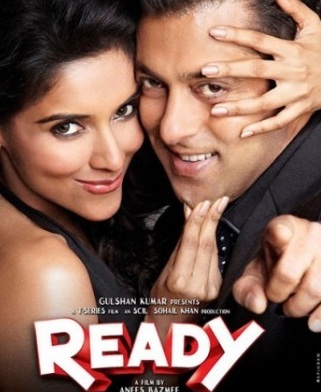 |
Ready Movie Poster
Parts of the film have been shot in Sri Lanka, Film City in Mumbai and Bangkok. In addition to the duo, the film also stars Arya Babbar, Paresh Rawal, Mahesh Manjrekar, Akhilendra Mishra, Manoj Joshi and Sudesh Lahiri in supporting roles. Ajay Devgn, Sanjay Dutt, Kangana Ranaut, Arbaaz Khan and Zarine Khan also have guest appearances.
The music of Ready has been composed by Pritam. The songs ‘Character Dheela’ and ‘Dhinka chika’ have already become popular. The film doesn’t feature too many songs though, just four original tracks along with their remixes is what comprises the music album.
 |
Asin
Delhi Belly
 |
Cast
- Imran Khan as Tashi
- Kunal Roy Kapoor as Nitin
- Vir Das as Arun
- Poorna Jagannathan as Sunita
- Shenaz Treasurywala as Kavita
- Vijay Raaz as Somayajulu
Synopsis
The film is a comedy that revolves around Tashi, Arun and Nitin – 3 flat mates who are regular blokes, living the regular life EXCEPT for one small detail – they are on the hit list of one of the world’s deadliest crime syndicates.Production
Earlier, Ranbir Kapoor and Chitrangada Singh were touted to star in the movie. After both of them backed off, Aamir signed his nephew Imran Khan[3] for the lead role after he attained tremendous success with his debut film Jaane Tu Ya Jaane Na. The shooting for the movie began in August 2008 and is scheduled to be completed in one long schedule in Delhi. The well known Indian comedian Vir Das has also been signed for the film to star in the lead role opposite Imran. According to director Abhinay Deo, “Delhi Belly is an ensemble piece. It’s not a film about Imran Khan. He is only one of the several protagonists. There are others whose characters as just as important. There is Kunal Roy Kapoor, Vir Das and Poorna Jagannathan, an Indian actress from LA”.[4] The film has been stuck on the edit table for a long time. Initially, Aamir was to spearhead the editing but he got busy with his own films. [5]Concept of movie and intervention by Kiran Rao
This movie is written by Los Angeles based writer Akshat Verma. It was thrown at script piles in Aamir Khan’s office, where Kiran Rao randomly picked it from the script piles, read it and began to laugh. Soon it was noticed by husband Aamir Khan, who also read it. Soon after this, he called the writer. Though he was hesitant because this might ruin the clean, family entertainment tag of his production house Aamir Khan Productions. This movie is based upon three Delhi based bachelors.[6]Release
This film is scheduled to release on July 1st, 2011 along with Amitabh Bachchan starrer Bbuddah… Hoga Tera Baap.[7]Editing
The film is edited by Huzefa LokhandwalaSoundtrack
The music of the film is composed by Ram Sampath while the lyrics are penned by Amitabh Bhattacharya, Munna Dhiman, Ram Sampath, Akshat verma and Chetan Shashital. The lyrics of the song D K Bose Aandhi Aayi are controversial ‘D K Bose, DK Bose,’ juxtaposed together and sung to fast instruments, is a popular expletive in India. Film writer Akshat Verma came up with the idea of using the key phrase DK Bose. Director Abhinay Deo and producer Aamir Khan thought that since the catch phrase went with the young and irreverent theme of the film, they gave their nod.[8]Track listing
| Title | Singer(s) | Music | Lyrics | Length |
|---|---|---|---|---|
| “Bhaag D.K. Bose, Aandhi Aayi” | Ram Sampath | Ram Sampath | Amitabh Bhattacharya | 04:02 |
| “Nakkaddwaley Disco, Udhaarwaley Khisko” | Keerthi Sagathia | Ram Sampath | Akshat verma, Munna Dhiman | 03:58 |
| “Saigal Blues” | Chetan Shashital | Ram Sampath | Chetan Shashital, Ram Sampath | 03:55 |
| “Bedardi Raja” | Sona Mohapatra | Ram Sampath | Amitabh Bhattacharya | 02:58 |
| “Jaa Chudail” | Suraj Jagan | Ram Sampath | Amitabh Bhattacharya | 03:18 |
| “Tere Siva” | Ram Sampath, Tarannum Mallik | Ram Sampath | Munna Dhiman | 04:39 |
| “Switty Tera Pyaar Chaida” | Keerthi Sagathia | Ram Sampath | Munna Dhiman | 02:53 |
| “I Hate You (Like I Love You)” | Keerthi Sagathia, Sona Mohapatra, Shazneen Arethna, Aamir Khan[9] | Ram Sampath | Akshat verma, Ram Sampath | 05:50 |
| “Bedardi Raja” – Grind Mix | Sona Mohapatra | Ram Sampath | Amitabh Bhattacharya | 03:04 |
| “Switty” – Punk | Keerthi Sagathia, Ram Sampath | Ram Sampath | Munna Dhiman | 03:30 |
Harry Potter and the Deathly Hallows – Part 2
 |
Plot
Following Dumbledore’s death, Voldemort completes his ascension to power and gains control of the Ministry of Magic. Harry, Ron, and Hermione leave Hogwarts to hunt and destroy Voldemort’s remaining horcruxes. They isolate themselves to ensure their friends and families’ safety. They have little knowledge about the remaining horcruxes except the possibility that two are objects once belonging to Hogwarts founders Rowena Ravenclaw and Helga Hufflepuff, and the third may be Nagini, Voldemort’s snake familiar. The whereabouts of the two founders’ objects is unknown, and Nagini is presumed to be with Voldemort. As they search for the Horcruxes, the trio learn more about Dumbledore’s past.Harry, Ron, and Hermione recover the first horcrux, Salazar Slytherin’s locket, by infiltrating the Ministry of Magic. Under the object’s evil influence and the stress of being on the run, Ron leaves the others. A mysterious silver doe leads Harry to the Sword of Godric Gryffindor, among the few objects able to destroy horcruxes. When Harry attempts to recover the sword, the horcrux attempts to kill him. Ron reappears, saving Harry and using the sword to destroy the locket. Resuming their search, the trio continually encounter a strange symbol, that an eccentric wizard named Xenophilius Lovegood tells them represents the mythical Deathly Hallows. The Hallows are three sacred objects: the Resurrection Stone, with the power to summon the dead to the living world; the Elder Wand, an unbeatable wand; and an infallible Invisibility Cloak. Harry learns that Voldemort is seeking the Elder Wand, but is unaware of the other Hallows and their significance. Harry decides that finding Voldemort’s horcruxes is more important than procuring the Hallows. They break into a Death Eater’s vault at the Wizarding Bank Gringotts to recover another horcrux, Helga Hufflepuff’s cup. Harry learns that another horcrux is hidden in Hogwarts. Harry, Ron, and Hermione enter the school and find the Horcrux, the Diadem of Ravenclaw, and destroy the cup and the diadem.
Voldemort and his followers besiege Hogwarts. Harry, Ron, and Hermione, their allies, and various magical creatures defend Hogwarts. Several major characters are killed in the first wave of the battle, including Remus Lupin, Nymphadora Tonks, Fred Weasley, and Severus Snape. Harry discovers while viewing the memories of Severus Snape that Voldemort inadvertently made Harry a horcrux when he attacked him as a baby and that Harry must die to destroy Voldemort. These memories also confirm Snape’s unwavering loyalty to Dumbledore and his role as spy in Voldemort’s camp. Harry surrenders himself to Voldemort, who casts the Killing Curse at him, sending Harry to a limbo-like state between life and death. There, Dumbledore explains that when Voldemort used Harry’s blood to regain his full strength, it protected Harry from Voldemort harming him; the Horcrux inside Harry has been destroyed, and Harry can return to his body despite being hit by the Killing Curse. Harry returns, the battle resumes, and after the last horcrux is destroyed, Harry finally kills Voldemort, and the wizarding world lives in peace once more.
Cast
- Daniel Radcliffe as Harry Potter, the film’s main protagonist.
- Rupert Grint as Ron Weasley, Harry’s best friend and Hermione’s romantic interest.
- Emma Watson as Hermione Granger, Harry’s other best friend and Ron’s romantic interest.
- Helena Bonham Carter as Bellatrix Lestrange, a Death Eater, the film’s secondary antagonist and Sirius Black’s cousin and murderer.
- Robbie Coltrane as Rubeus Hagrid, Harry’s half-giant friend and a former teacher at Hogwarts.
- Tom Felton as Draco Malfoy, Harry’s archnemesis and death eater.
- Ralph Fiennes as Lord Voldemort, the primary antagonist, a merciless power-hungry wizard, and the leader of the Death Eaters.
- Michael Gambon as Albus Dumbledore, former headmaster of Hogwarts killed by Severus Snape two films earlier.
- Maggie Smith as Minerva McGonagall, the transfiguration teacher, Deputy Headmistress and future Headmistress at Hogwarts.[10]
- John Hurt as Ollivander, a wandmaker abducted by the Death Eaters.
- Jason Isaacs as Lucius Malfoy, Draco Malfoy’s father and a disgraced Death Eater.
- Alan Rickman as Severus Snape, a spy to the Death Eaters and the new headmaster of Hogwarts.
- David Thewlis as Remus Lupin, a member of the Order of the Phoenix and a former teacher at Hogwarts.
- Julie Walters as Molly Weasley, the Weasley matriarch and a mother figure to Harry.
- Jim Broadbent as Horace Slughorn, the potions master at Hogwarts.[11]
- Gary Oldman as Sirius Black, Harry’s godfather. Killed in battle three films earlier by Bellatrix Lestrange.[12]
- Emma Thompson as Sybill Trelawney, the divination teacher at Hogwarts.[13]
Director David Yates has announced that, for the final scene in the film which is set nineteen years after the film’s main story, older actors will not be cast to play the main characters. Special effects will be used to depict the cast members as adults.[15]
Production
Main article: Production of Harry Potter and the Deathly Hallows
Part 2 was filmed back-to-back with Harry Potter and the Deathly Hallows – Part 1 from 19 February 2009 to 12 June 2010, with reshoots for the Epilogue scene taking place at Leavesden Film Studios on 21 December 2010. Director David Yates described Part 2 as “operatic, colourful and fantasy-oriented”, a “big opera with huge battles.”[16][17]Soundtrack
Main article: Harry Potter and the Deathly Hallows ? Part 2 (soundtrack)
See also: Harry Potter music
Composer of the first three films, John Williams, expressed interest in returning for Deathly Hallows – Part 2 if it fit his schedule. Director David Yates stated that he was eager to work with Williams on the score, but it was not possible due to their conflicting schedules.[18] It was confirmed via the Warner Bros. website that Part 1 composer, Alexandre Desplat, was set to return for Part 2.[19][20] In an interview with Film Music Magazine, Desplat stated that scoring Part 2 is “a great challenge” and that he has “a lot of expectations to fulfill and a great deal of work” ahead of him.[21] Desplat started writing the music in early 2011 and finished recording with orchestrator Conrad Pope and the London Symphony Orchestra on 27 May 2011 at Abbey Road Studios, as stated on Pope’s official Facebook page.[22][23]Marketing
In March 2011, the first preview for Deathly Hallows – Part 2 was released revealing new footage and new interviews from the starring cast.[24] A teaser poster was released on 28 March 2011 with the caption “It All Ends 7.15″ (referring to its international release date).[25] On 27 April 2011, the first theatrical trailer for Part 2 was released. The trailer revealed a range of new and old footage.[26] A month later, a set of seven posters was released each illustrating a different character with the caption “It All Ends 7.15″ and a background depicting the Battle of Hogwarts.[27]Release
On 2 April 2011, a test screening of Part 2 was held in Chicago. Director David Yates, producers David Heyman and David Barron and the film’s editor Mark Day were in attendance.[28]Part 2 will have its world premiere on 7 July 2011 at Trafalgar Square in London.[29]
Subscribe to:
Posts (Atom)